

Two Modes, One Screen
Lets understand difference between oral and written culture.

Some of the best conversations I’ve had lasted under three minutes. They don’t stick in memory — but they open a door. They make the next, deeper conversation possible.
I’ve started thinking of these as two very different things. The quick, unexpected exchange. And the long, unhurried sit-down. The more I think about it, the more I believe this reflects something deep about how humans communicate.
Researchers call it the difference between oral and written culture.
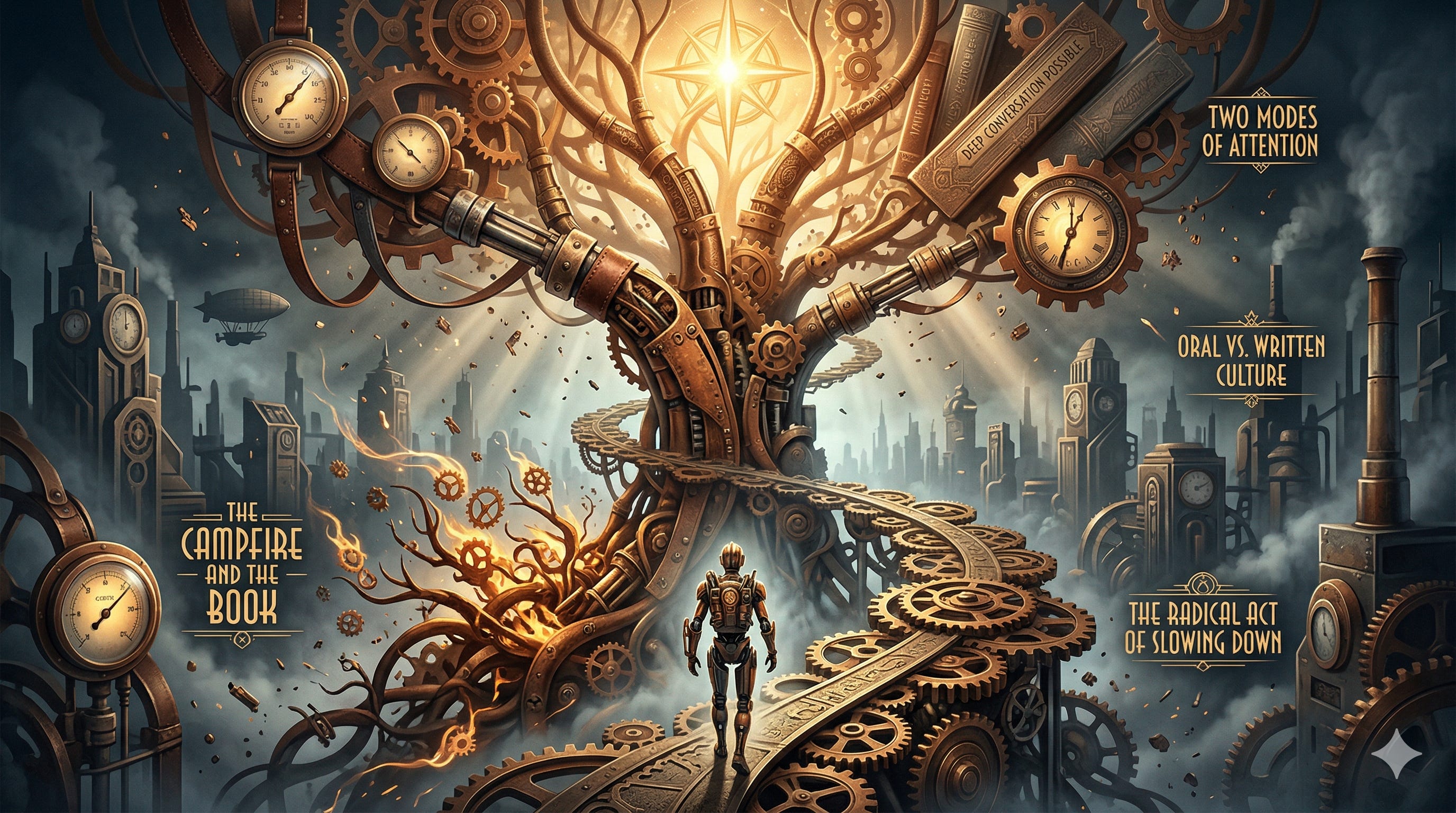
Oral culture is the campfire. Stories, emotion, energy passing directly from one person to another. It’s how humans talked for most of history — and it’s still our default when we’re not paying attention. Written culture is the book. Ideas laid out carefully, built to outlast the person who wrote them.
For most of modern history, these two stayed separate. Newspapers were calm and reasoned. Television was emotional and immediate. Different tools, different purposes.
The internet mixed everything together.
Now the same screen shows you a TikTok and a three-hour podcast. A tweet and a long essay. But here’s what I find interesting: the format no longer tells you what kind of content you’re getting. The depth does.
A tweet — even though it’s made of words — is campfire culture. It’s a shout, built to create heat, not light. A long podcast that actually wrestles with ideas? That’s a book wearing headphones. The medium is just the surface. What matters is the depth.
I’ve been hosting long conversations for seven years. What’s kept me going isn’t discipline — it’s curiosity. Real curiosity makes you want to stay in a conversation past the point where most people reach for their phone.
But curiosity alone isn’t enough. I’ve slowly learned that truly following someone else’s thinking — not just waiting for your turn to talk, but actually listening — takes real effort. It requires the same kind of attention as meditation. A quiet decision to stay present when everything in you wants to drift.
That’s what these two modes of communication really ask of us: two different relationships with attention.
And right now, everything is pushing us toward the shorter one. The feeds, the algorithms, every platform we use — all of it is pulling us toward the campfire. Toward reaction instead of reflection.
I get the pull. I feel it too.
But the conversations that have actually changed me were never the quick ones. They were the ones where someone was willing to go long. To stay with an idea past the point of comfort. To let depth do its slow work.
In a world rushing toward the campfire, choosing to slow down — in a book, in a conversation, in your own head — might be the most quietly radical thing you can do.